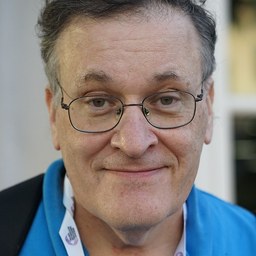
约翰·普拉特John Platt
Google Research
谷歌院士 · 应用科学负责人Google Fellow · Applied Science lead
deep-learningsystems
他写下了经典机器学习里几乎人人都在用、却很少叫得出名字的两块东西:1998 年的 SMO,让支持向量机的训练第一次变得可算;1999 年的 Platt scaling,把分类器的原始分数变成校准过的概率。在微软研究院多年后加入谷歌,如今领导应用科学——把计算机科学对准物理与生物问题,气候是主攻方向。2006 年因计算机图形学工作获技术类奥斯卡奖,另有两颗以他命名的小行星。近期工作包括一套智能体式研究系统,起点是「把 Kaggle 自动化」的尝试,用大模型加树搜索来改进实验。
Wrote two of the pieces of classical machine learning that almost everyone still uses without naming them: SMO (1998), which made training support vector machines tractable, and Platt scaling (1999), which turns a classifier's raw scores into calibrated probabilities. Spent years at Microsoft Research before joining Google, where he now leads Applied Science — computer science pointed at physical and biological problems, with climate as the main target. Won a Technical Academy Award in 2006 for computer graphics work, and has two named asteroids. Recent work includes an agentic research system that grew out of an attempt to automate Kaggle and combines LLMs with tree search to improve experiments.
在关系图谱中查看 John Platt →View John Platt in the graph →
听 John Platt 的 AI 播客 →Listen on AI Podcast →